

In the Democratic Republic of Congo (DRC), access to justice remains a major challenge, particularly for people living far from urban centres. In some regions, especially in the eastern part of the country, protracted conflicts have led to serious violations of fundamental rights, calling for judicial responses and reparation mechanisms adapted to the needs of affected communities.
In response to this reality, Avocats Sans Frontières (ASF) has helped develop an innovative approach to addressing international crimes: mobile court hearings.
The idea is simple: when justice is too far removed from those seeking it, it must go to them.
A concrete response to the remoteness of justice
In the early 2000s, when ASF began its activities in the DRC, the organisation observed that a large part of the population remained excluded from the judicial system. Distances, the cost of proceedings and the lack of infrastructure all constituted major obstacles to accessing justice.
In this context, ASF decided to support the organisation of hearings directly within communities. The objective was clear: to enable courts to travel and hear cases as close as possible to the people concerned, particularly in conflict-affected areas.
“We organised the first mobile court hearings, during which we brought lawyers, court clerks and magistrates to remote areas so that local populations living far from courts could access justice. It was a highly ambitious project involving complex logistics; people thought we were crazy, but we managed to make it happen,” recalls Francesca Boniotti, then Head of Mission for ASF in the DRC.
Dominique Kamuandi, now Thematic and Strategic Coordinator at ASF in the DRC, shares the same view: “When we launched this project, many people thought it was unrealistic.”
Yet mobile court hearings had already been provided for under Congolese law since 1979, although they had never previously been implemented.
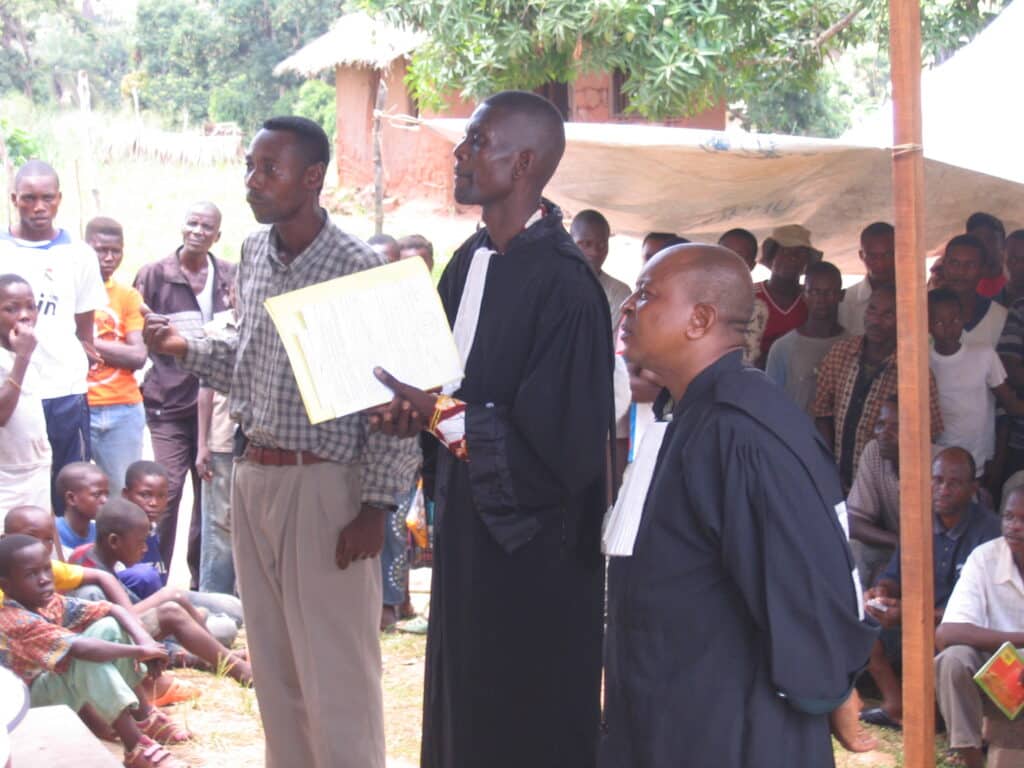
An approach that became a model
Despite initial reluctance, ASF launched a first pilot project. The results quickly followed: people who had never had access to a court were finally able to assert their rights.
The success of the initiative exceeded expectations. Other actors gradually began adopting the mechanism, which eventually became integrated into the practices of judicial authorities. ASF also contributed to the development of institutional frameworks and tools governing mobile court hearings.
What was initially seen as a bold idea progressively became a widely used model for bringing justice closer to communities. Today, ASF continues to support the organisation of mobile court hearings in collaboration with judicial authorities, the United Nations and other civil society organisations.
A key tool in the fight against impunity
Trials for international crimes are generally held in provincial capitals, often far from conflict zones and affected communities. In this context, mobile court hearings have progressively become an essential tool in the fight against impunity.
In situations marked by mass violence, the absence of justice fuels cycles of violence over the long term. By bringing justice closer to communities, mobile hearings also help restore public trust in judicial institutions. Seeing justice take place locally, hearing victims and judging crimes within affected communities has both a symbolic and tangible impact.
These initiatives aim to respond to the needs of populations and victims while also contributing to the long-term strengthening of social cohesion.
Justice in the service of victims
For ASF, mobile court hearings are part of a broader vision of access to justice: justice that is accessible, fair, close to communities and centred on the needs of those seeking justice.
Beyond organising hearings, ASF strengthens judicial actors, collaborates with Congolese lawyers and supports victims throughout legal proceedings, placing their needs at the centre of its work.
Today, the organisation also works to support victims in obtaining reparations for the harm they have suffered. This comprehensive approach aims to ensure justice that is not only accessible, but also of high quality and capable of providing reparations adapted to the needs of affected communities.
Landmark cases
To date, nearly 160 trials for international crimes have taken place in the DRC, mainly in the provinces of Kivu and Ituri. These trials have involved both state and non-state armed actors, most of whom were prosecuted for war crimes and crimes against humanity.
ASF has supported at least 85 judicial cases concerning international crimes before Congolese courts. Landmark cases include:
the Yumbi case, involving a national member of parliament and more than 90 other defendants
the Songo Mboyo case, the first ruling in which a Congolese judge directly applied the Rome Statute;
the Yalisika case, the first case involving international crimes committed outside conflict zones, in Equateur province, and linked to the exploitation of natural resources;
the Cheka case, which led to the conviction of a notorious North Kivu warlord for war crimes;