This article is part of ASF’s 2025 annual report
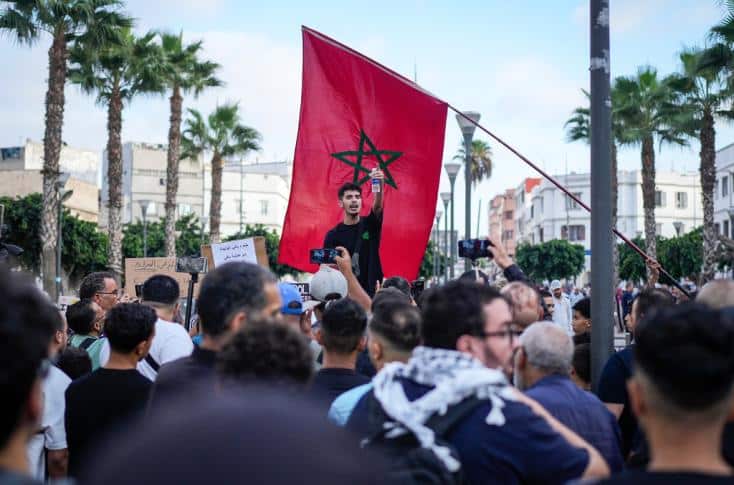
In 2025, Generation Z-led mobilisations took place in several cities across Morocco. Driven by demands related to socio-economic conditions, access to public services and more meaningful civic participation, these mobilisations led to arrests and the initiation of legal proceedings against young protesters.
In this context, ASF mobilised its pool of lawyers through its legal aid mechanisms to provide legal support to the young people who had been arrested. This intervention helped ensure their access to legal representation, monitor the proceedings brought against them and document the conditions under which these prosecutions were conducted.
Understanding experiences through a gender lens
The analysis of the cases handled through this legal assistance quickly revealed dynamics extending beyond the mobilisations themselves.
By adopting an intersectional approach, ASF found that young women involved in these mobilisations were exposed to specific forms of pressure. Beyond legal proceedings, their experiences reveal targeting mechanisms linked both to their activism and to their gender identity.
Some were arrested ahead of demonstrations on the basis of their presumed participation. Others were prosecuted under broadly defined criminal charges applied to forms of peaceful mobilisation.
These situations reflect a broader reality: young women’s participation in public life remains constrained by a combination of legal restrictions, social pressures and symbolic delegitimisation.
A key partnership with the Young Women for Democracy Group
To deepen this analysis, ASF strengthened its documentation work in partnership with the Young Women for Democracy Group (JFD).
Committed to promoting young women’s participation in public life, the JFD Group works concretely to remove the barriers that hinder their engagement. Its work aims to increase the visibility of the discrimination they face, strengthen their capacity to act, raise awareness of their situation and advocate for conditions that enable them to participate fully in public life.
The partnership with the JFD Group has helped ground the analysis in lived realities, strengthen the documentation of violations and bring greater visibility to the experiences of women activists that are often marginalised or overlooked.
The documented cases show that the pressures they face extend beyond the judicial sphere. They form part of a broader set of mechanisms, including smear campaigns, social stigmatisation and attacks targeting women activists’ reputations or private lives.
Restrictions that reveal the state of civic space
Evidence gathered through legal assistance and documentation points to dynamics that go beyond individual cases and directly raise questions about the conditions in which civic space operates in Morocco.
When forms of civic participation — whether mobilisation, online expression or collective action — are approached through a criminal-law lens, the boundary between legitimate expression and criminal conduct becomes increasingly blurred. Criminal law then ceases to function solely as a means of regulating conduct and becomes, de facto, a tool for regulating public expression.
This development creates lasting legal uncertainty. It not only results in individual sanctions but also contributes to a broader chilling effect. It helps redefine the boundaries of what can be said and challenged, particularly for those who are most exposed.
For women human rights defenders, these restrictions take on a specific dimension. The mechanisms observed are not limited to legal proceedings. They are accompanied by strategies of delegitimisation targeting women’s identity, morality or behaviour, shifting the debate away from the political sphere and into the social realm.
This shift is far from insignificant. It discredits activism by portraying it as a violation of social norms rather than a legitimate contribution to democratic debate. In doing so, it becomes an informal yet particularly effective means of regulating women’s participation in public life.
These dynamics have consequences that extend far beyond individual experiences. They shape the conditions under which women are able — or unable — to participate, speak out and advance collective demands.
In this sense, the situation of women human rights defenders is not a sector-specific issue. Rather, it serves as a structural indicator of the state of civic space: when certain voices are discouraged, delegitimised or subjected to differentiated forms of pressure, the very capacity of democratic debate to reflect the diversity of social experiences is weakened.
Taking action to protect and increase visibility
The experience of the 2025 mobilisations confirmed the need to combine legal assistance, documentation and advocacy.
Through its legal aid mechanisms, ASF works to guarantee access to justice for people facing prosecution in connection with their activism. Through its partnerships, particularly with the JFD Group, the organisation helps bring visibility to realities that often remain unseen and contributes to developing a clearer understanding of the dynamics affecting civic space.
By paying particular attention to the experiences of women activists, ASF reaffirms its commitment to promoting human rights and protecting an open civic space in which those whose voices are most at risk can continue to speak out.